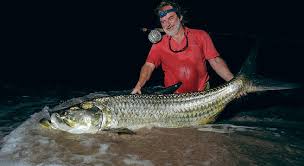
Sette Cama, located at the mouth of the Ndogo Lagoon and the Atlantic Ocean in the southern region of Loango National Park, is globally renowned for hosting a population of massive Atlantic tarpon (Megalops atlanticus). In these wild, nutrient-rich waters, specimens regularly exceed 70 to 100 kg (150 to 220+ lbs).
This guide outlines the optimal seasons, specialized tackle, and technical angling tactics required to target the Atlantic’s « Silver King. »
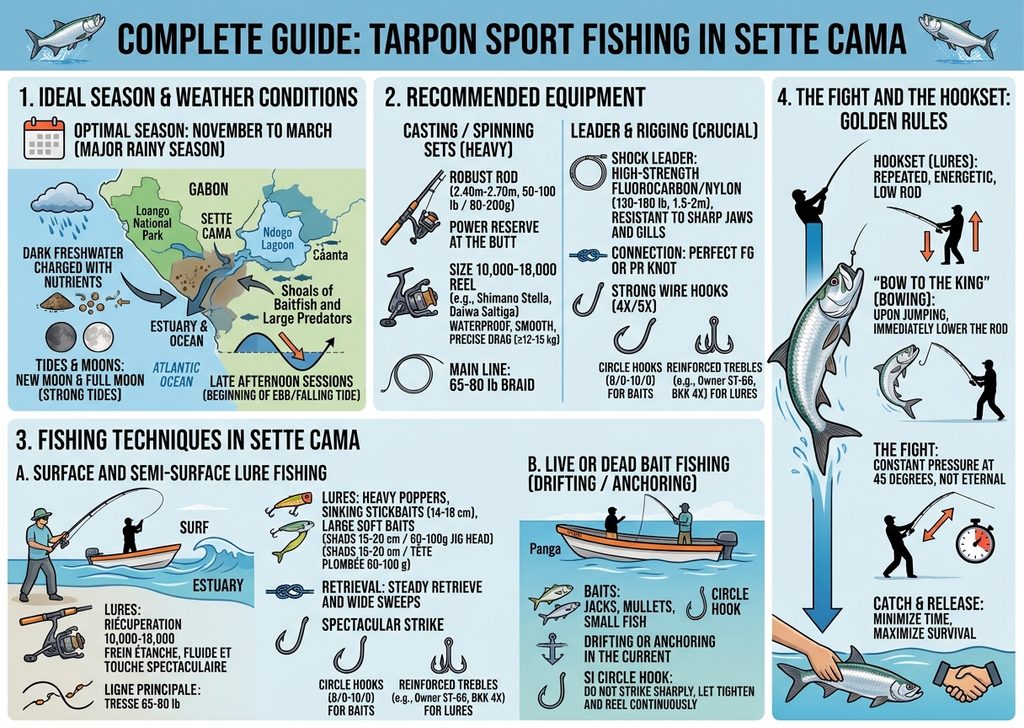
1. Prime Season & Weather Conditions
The angling season at Sette Cama is closely tied to precipitation patterns and tarpon migratory movements.
- Peak Season: November through March (the main rainy season).
- Water Conditions: Heavy rainfall generates a high volume of dark, tannin-rich freshwater runoff flowing from the lagoon into the estuary and ocean, concentrating baitfish shoals and apex pelagic predators.
- Tides & Lunar Phases: New moon and full moon phases generate strong tidal coefficients. Late afternoon outings during tidal transitions (the onset of the ebb tide/falling water) consistently yield peak feeding activity.
2. Recommended Tackle & Equipment
Tarpon possess heavily ossified, bony jaws, powerful muscular bodies, and exhibit violent aerial acrobatics. Gear integrity must be flawless to prevent line breakage or hook straightening.
Heavy Spinning Gear
- Rod: Heavy-duty 2.40 m to 2.70 m (7’10 » to 9′) spinning rod rated for 50–100 lb line (casting weight: 80–200 g), featuring substantial backbone power in the butt section to exert maximum leverage.
- Reel: 10,000 to 18,000 size spinning reel (e.g., Shimano Stella SW, Daiwa Saltiga) featuring a sealed, smooth drag system calibrated with precision (minimum 12–15 kg of effective drag force).
- Mainline: 65 to 80 lb braided line.
Leaders & Terminal Tackle (Critical)
- Shock Leader: 130 lb to 180 lb heavy-duty fluorocarbon or monofilament (1.5 to 2 meters). The tarpon’s bony mouth plates and razor-sharp gill covers will easily chafe through lighter leader material.
- Connection Knot: A flawlessly tied FG knot or PR bobbin knot connecting braid to the shock leader.
- Hooks: 4X or 5X heavy-wire Circle Hooks (sizes 8/0 to 10/0) for bait fishing, or heavy-wire reinforced treble hooks (Owner ST-66 / BKK 4X) for artificial lures.
3. Angling Techniques at Sette Cama
Fishing at Sette Cama is primarily conducted from light panga-style craft, as well as via surf-casting from the beach along the shore-break zone near the estuary mouth.
A. Surface & Sub-Surface Lure Fishing
- Lures: Heavy poppers, sinking stickbaits (14 to 18 cm), and large soft plastics (15–20 cm shads rigged on 60–100 g heavy-wire jig heads).
- Retrieval: Steady linear retrieval interrupted by wide sweeps of the rod tip. Strikes are typically explosive near the boat or directly behind the surf line.
B. Live & Dead Baiting (Drift / Anchored)
- Bait: Live jacks, mullet, or local finfish rigged under a float or drifted along the main estuarine current seam.
- Circle Hook Setting: When utilizing circle hooks, do not execute a hard sweep. Allow the line to come taut and wind steadily; the hook will pivot and set naturally in the corner of the mouth.
4. Hooksets & Fighting Strategy: The Golden Rules
- The Hookset (Lures): Due to the tarpon’s bony mouth, execute multiple firm, low-rod-angle strike sets immediately upon contact to drive the hook barb home.
- « Bowing to the Tarpon »: The moment the tarpon breaches the surface to jump, immediately lower the rod tip toward the fish to slaken the line. Landing on a taut line almost guarantees a leader snap or pulled hook.
- The Fight: Maintain steady 45-degree side pressure to exhaust the fish efficiently without over-stressing the gear. Avoid unnecessarily prolonged battles to maximize post-release survival rates (Catch & Release).

Laissez votre avis